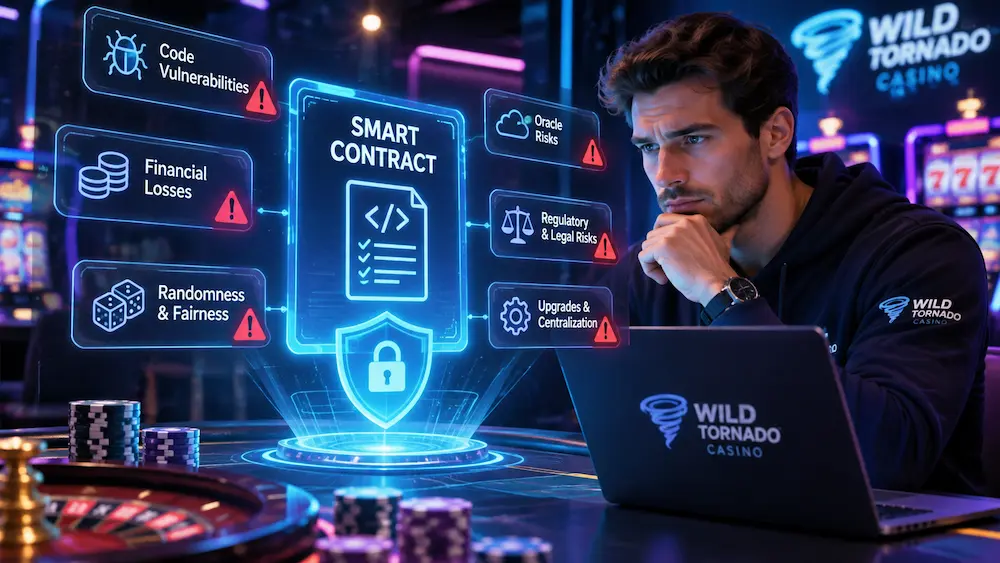
smart contract risks in iGaming
Smart contracts are transforming the online gambling industry by introducing automated transactions, blockchain transparency, and new ways to verify gaming outcomes. However, despite their advantages, smart contracts in iGaming also introduce significant security, financial, and regulatory risks.
Understanding these risks is essential for both casino operators and players interested in blockchain gambling. From coding vulnerabilities to unreliable external data, even decentralized systems require careful security management.
What Are Smart Contracts in iGaming?
A smart contract is a self-executing program deployed on a blockchain. It automatically performs predefined actions when specific conditions are met, without requiring manual approval for every transaction.
In the iGaming industry, smart contracts can support several functions:
Automated payouts: Distributing winnings when predefined game conditions are satisfied.
Blockchain gambling: Recording wagers and transactions on a distributed ledger.
Provably fair gaming: Supporting systems in which players can independently verify certain game outcomes.
Bonus distribution: Automating eligible rewards based on predefined conditions.
Decentralized betting: Managing bets and settlements without relying entirely on traditional payment infrastructure.
Although these capabilities can improve transparency and efficiency, automated execution also creates new challenges.
1. Smart Contract Coding Vulnerabilities
One of the biggest risks of smart contracts in online gambling is the possibility of programming errors.
Unlike traditional software, deployed smart contracts can be difficult to modify, especially when they are designed to be immutable.
Common vulnerabilities include:
Reentrancy attacks: Exploiting external calls to trigger unintended repeated operations.
Access control failures: Allowing unauthorized users to execute privileged functions.
Arithmetic and precision errors: Producing incorrect balances, calculations, or payouts.
Logical vulnerabilities: Causing unexpected behavior when specific conditions are met.
A programming mistake in a gambling contract could result in incorrect payouts, frozen funds, or financial losses.
Security specialists therefore recommend comprehensive code reviews, automated testing, and independent smart contract audits.
2. Financial Losses and Irreversible Transactions
Blockchain transactions are generally difficult or impossible to reverse once finalized.
This creates a particular challenge for smart contracts handling casino deposits, wagers, and withdrawals.
For example, if a smart contract transfers winnings to an incorrect wallet address, recovering those funds may be extremely difficult.
Other financial risks include:
Incorrect payout calculations.
Unauthorized transfers caused by exploits.
Funds becoming permanently locked in a contract.
Unexpected transaction fees during network congestion.
Losses caused by compromised administrative keys.
Players should also understand that cryptocurrency price volatility can change the fiat value of their balances, independently of the smart contract itself.
3. Oracle Manipulation and Unreliable Data
Smart contracts cannot automatically access all information outside their blockchain environment.
To use external information, they often depend on services called blockchain oracles.
In iGaming, oracles may provide sports results, asset prices, or other information needed to settle wagers.
If an oracle delivers inaccurate or manipulated data, a smart contract may execute an incorrect payout.
For example, a decentralized sports betting platform might rely on an external data provider to determine the winning team.
If that data is compromised, the contract could settle bets incorrectly.
Using multiple independent data sources, validation procedures, and decentralized oracle networks can reduce these risks.
4. Randomness and Game Fairness Risks
Randomness is fundamental to many casino games.
Traditional online slots and other digital games typically rely on random number generators (RNGs) to determine outcomes.
Blockchain-based gambling platforms may use alternative mechanisms, including cryptographic commitments and verifiable random functions.
However, implementing randomness incorrectly can introduce security vulnerabilities.
Potential problems include:
Predictable random values.
Manipulation of game outcomes through blockchain data.
Unreliable randomness providers.
Incorrect verification mechanisms.
Delayed or unavailable randomness responses.
A smart contract does not automatically guarantee fair gameplay simply because its code operates on a blockchain.
The randomness mechanism, game rules, and payout calculations must also be properly designed and independently evaluated.
5. Regulatory and Legal Risks
The legal environment surrounding blockchain gambling remains complex.
Smart contracts may automate wagering and payments, but their use does not eliminate gambling regulations.
Depending on the jurisdiction, operators may need to satisfy requirements involving:
Gambling licensing.
Know Your Customer (KYC) verification.
Anti-Money Laundering (AML) controls.
Consumer protection.
Responsible gambling.
Transaction monitoring and reporting.
An important challenge is that decentralized technology can make it harder to identify which individuals or organizations are responsible for certain operations.
Casino operators must therefore consider how blockchain functionality fits into applicable gambling regulations.
6. Smart Contract Upgrades and Centralization Risks
Although decentralization is frequently presented as an advantage of blockchain technology, not every smart contract is fully decentralized.
Some contracts include administrative privileges that allow authorized parties to pause operations, update implementations, or modify selected parameters.
These capabilities can help address vulnerabilities, but they also introduce risks.
A compromised administrator account could potentially interfere with contract operations.
Likewise, an upgrade could introduce new vulnerabilities or change how a gaming platform operates.
Secure access controls, multisignature authorization, transparent upgrade procedures, and independent reviews can reduce these threats.
7. Network Congestion and Transaction Delays
Smart contracts operate within blockchain networks that have their own performance limitations.
When transaction demand increases, network congestion may cause higher fees and slower confirmation times.
In iGaming, this can affect:
Deposits and withdrawals.
Automated reward distribution.
Time-sensitive betting transactions.
Game settlement processes.
The overall player experience.
A delayed transaction may become especially problematic when a betting market closes or an event begins before the transaction is confirmed.
Platforms must account for network conditions when designing blockchain-based gaming systems.
How Can iGaming Platforms Reduce Smart Contract Risks?
Although smart contract vulnerabilities cannot be eliminated entirely, operators can significantly improve security through responsible development and monitoring.
Independent security audits
Have qualified specialists review contract code before deployment and after significant changes.
Comprehensive testing
Use automated security analysis, adversarial testing, and simulations of unusual gaming scenarios.
Secure access management
Protect privileged functions through limited permissions, multisignature controls, and secure key management.
Continuous monitoring
Monitor contract activity, unusual transactions, liquidity, and possible attacks.
Regulatory compliance
Ensure gambling operations, customer verification, and financial processes meet applicable legal requirements.
Security recommendations from Ethereum and the OWASP Smart Contract Top 10 provide additional guidance on preventing common vulnerabilities.
Are Smart Contracts the Future of Online Gambling?
Smart contracts have the potential to become an important component of future iGaming infrastructure.
Their ability to automate payments, support transparent transactions, and enable verifiable gaming systems makes them attractive to blockchain developers and gambling technology providers.
However, widespread adoption depends on overcoming several challenges.
Security standards must continue to improve, regulatory requirements must be addressed, and platforms need to create practical interfaces for players unfamiliar with cryptocurrency technology.
Traditional online casinos and blockchain-based gaming platforms may also coexist, using different technologies to deliver secure and convenient entertainment.
At WildTornado Casino, understanding emerging technologies such as blockchain and smart contracts is part of exploring how the digital gambling industry continues to evolve.
Conclusion
Smart contracts can improve automation and transparency in iGaming, but they also introduce important risks involving software vulnerabilities, financial security, oracle reliability, randomness, and legal compliance.
The most serious problems often arise when automated systems depend on flawed code, compromised data, or inadequate operational safeguards.
For players and operators alike, the key lesson is simple: blockchain technology can support trustworthy gaming experiences, but security depends on proper implementation, independent verification, and responsible management.
Frequently Asked Questions (FAQ)
Are smart contracts safe for online gambling?
Smart contracts can support secure gambling transactions when they are carefully developed, independently audited, and properly monitored. However, coding errors, compromised keys, and external data vulnerabilities can still create significant risks.
Can hackers steal money from smart contracts?
Yes. Attackers may exploit programming vulnerabilities, weak access controls, or compromised administrative credentials to transfer or lock funds. Security audits and protective development practices can reduce these risks.
Can smart contracts guarantee fair casino games?
No. Smart contracts can enforce predefined rules and support verifiable outcomes, but fairness also depends on secure randomness, correct game logic, and reliable external data.
What happens if a smart contract fails during a casino payout?
The result depends on the contract design and the type of failure. A transaction may revert, funds may remain locked, or an incorrect transfer may occur. Some problems can be corrected through authorized recovery mechanisms, while others may be irreversible.
Are blockchain casinos regulated?
Blockchain-based casinos may be subject to gambling, financial, and consumer protection regulations. Specific requirements depend on the jurisdiction and the platform’s operating model.
How can players identify safer blockchain gambling platforms?
Players should look for appropriate licensing, transparent gaming rules, credible independent security audits, clear withdrawal policies, verifiable fairness mechanisms, and accessible customer support.
Author

 I am the Director of a company that specializes in providing a range of services including marketing analytics, web design, email marketing, content creation, and graphic design. With over 13 years of experience in analytics and marketing, I have successfully managed teams and developed strategies that cater to various client needs. My role involves overseeing projects, ensuring quality service delivery, and driving business growth through effective marketing solutions.

 I am the Director of a company that specializes in providing a range of services including marketing analytics, web design, email marketing, content creation, and graphic design. With over 13 years of experience in analytics and marketing, I have successfully managed teams and developed strategies that cater to various client needs. My role involves overseeing projects, ensuring quality service delivery, and driving business growth through effective marketing solutions.